

There is no fixed number of times you can polish a car before the clear coat is gone. The safe number depends on the thickness of the clear coat, how much material each polishing session removes, the abrasiveness of the product, the pad and machine used, and how aggressively the surface is worked.
Modern automotive clear coats are commonly around 30 to 50 microns thick, although the actual thickness varies by vehicle and panel.
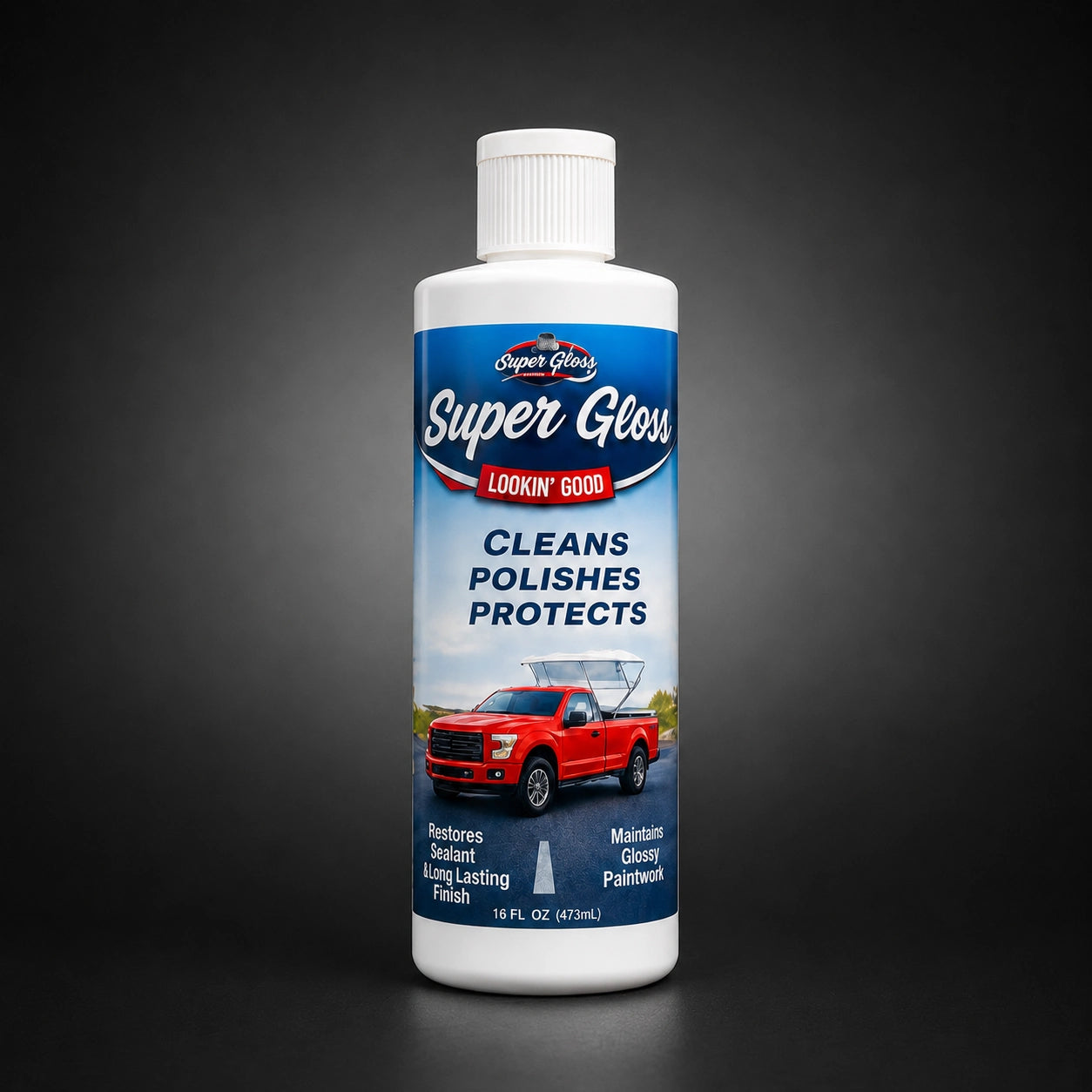
One Polish. Multiple Surfaces.
Skip the need for separate detailing products. Super Gloss combines cleaning, polishing, shining, and sealing in one multi-surface formula.
The important rule is simple: polish when the paint needs correction, not simply because a certain amount of time has passed. If the finish already looks good, protecting it is usually better than removing more clear coat.
Why Does Polishing Remove Clear Coat?
Polishing is often described as making scratches disappear, but the process is more precise than that. Abrasive polish levels the clear coat around a shallow defect so the surface becomes more uniform. The scratch itself is not magically pulled out. Material surrounding the defect is reduced until the surface reflects light more evenly.
That means an abrasive polishing session can remove at least a microscopic amount of clear coat. Fine finishing polishes generally remove less material than aggressive compounds. Machine speed, pad type, pressure, number of passes, paint hardness, and time spent in one area all affect the amount removed.
3M describes automotive polishing systems as being used to remove sanding scratches and swirl marks from OEM and refinished paint, which illustrates the corrective nature of polishing rather than simple cleaning.
How Thick Is a Car's Clear Coat?
A typical modern automotive clear coat is only a small part of the overall paint system. Current detailing references commonly place clear-coat thickness around 30 to 50 microns, although actual thickness varies by manufacturer, model, panel, paint system, and repair history. The complete factory paint stack is considerably thicker because it includes primer, base coat, and other layers underneath the clear.
A micron is one thousandth of a millimeter. That makes 30 to 50 microns extremely thin. It is also why a paint correction that looks gentle to the eye still needs to be treated as material removal.
There is another complication: clear coat is not necessarily the same thickness across an entire vehicle. Edges, body lines, corners, and previously repaired panels can have different readings from large, flat sections. A hood may not have the same remaining clear-coat thickness as a door or fender.
So, How Many Times Can You Polish a Car?
There is no responsible universal number such as five, ten, or twenty. A car that has received several aggressive corrections may have less remaining clear coat than a similar car that has only received one gentle polish.
One current industry reference estimates a typical machine-polishing session at about 1 to 3 microns of clear-coat removal, with aggressive compounding potentially removing around 4 to 10 microns. Those figures are examples rather than guarantees because actual removal depends heavily on the process.
This is why counting polishing sessions can be misleading. Five light finishing passes over several years may remove less material than one aggressive correction performed with a heavy compound and cutting pad.
Instead of asking, “How many times can I polish it?” a better question is, “How much clear coat does this panel have left, and how much correction does it actually need?”
What Determines How Much Clear Coat You Remove?
Several factors determine how much material a polishing session removes.
Polish Abrasiveness
A finishing polish is designed for lighter refinement and generally removes less material than a heavy-cut compound. If the paint only has light swirls or haze, starting with an aggressive compound creates unnecessary risk.
Pad Choice
Pads can range from very soft finishing pads to more aggressive cutting pads. A stronger combination can correct defects faster, but it can also remove more clear coat.
Machine and Speed
Machine polishing can produce substantially more correction than hand application. Rotary polishers can remove material quickly when used with an aggressive setup. Dual-action polishers are commonly used for controlled correction, but they can still remove clear coat.
Pressure and Number of Passes
More pressure and repeated passes over the same area increase the amount of correction. Staying in one spot too long can also create excess heat and concentrate material removal.
Paint Condition
A vehicle with original, healthy paint may have more correction margin than a panel that has already been wet-sanded or polished several times. Repainted panels can also have different film thickness from factory panels.
What Happens When You Polish Too Much?
The biggest problem with excessive polishing is reducing the clear coat to the point where it can no longer provide adequate protection.
Clear coat helps protect the color layer from environmental exposure while providing the gloss associated with modern automotive finishes. When too much is removed, the remaining paint has less margin for future correction and greater risk of failure.
If polishing cuts through the clear coat and exposes the color coat, the problem is no longer a detailing issue that another polish can solve. The panel may require professional refinishing.
Signs of serious clear-coat damage can include peeling, cracking, localized discoloration, or areas where the finish no longer has the same gloss or texture as surrounding paint. If you see those symptoms, stop polishing and have the panel evaluated.
Can You Tell How Much Clear Coat Is Left?
Not by looking at the paint alone. A paint thickness gauge can measure the total thickness of the coating system over a compatible metal panel, but it generally cannot tell you exactly how much of that measurement is clear coat.
That distinction matters. A reading of 120 microns does not automatically mean 40 or 50 microns of clear coat remain. The measurement can include primer, base coat, clear coat, and previous refinishing material.
Professionals can use multiple readings across a panel and compare adjacent panels to identify unusually thin or thick areas. A gauge is therefore useful for identifying risk, but it is not a magic device that gives an exact remaining clear-coat number.
What About Using Car Polish for Scratches?
If a scratch is shallow and confined to the clear coat, polishing may reduce its appearance. But polishing is not appropriate for every scratch.
Clean the panel and examine the scratch under good lighting. If it is deep enough to catch your fingernail, it may extend beyond the level that a safe polish can correct. If you can see a different color underneath, especially primer or bare material, polishing will not repair the damage.
Using more aggressive compound simply because a scratch remains visible can remove unnecessary clear coat without producing a satisfactory repair.
For light defects, a mild car polish for scratches can be a reasonable starting point. Test a small area first and use the least aggressive method that produces the result you need.
How Often Should You Polish a Car?
Do not polish your car according to a rigid annual schedule. Inspect the paint and polish only when correction is actually necessary.
A well-maintained vehicle may go a long time between polishing sessions. If careful washing, drying, and protection keep the paint glossy and free from significant defects, there is little reason to remove more clear coat.
Super Gloss Sealant's own guidance similarly recommends polishing based on visible paint condition rather than treating it as a routine step after every wash.
Frequent polishing can become counterproductive. The better long-term strategy is to prevent new defects so you do not have to keep correcting them.
How Can You Reduce the Need for Polishing?
The easiest way to preserve clear coat is to avoid creating defects in the first place.
Wash the vehicle with clean equipment and automotive-safe soap. Use soft microfiber wash media and avoid dragging heavy dirt across dry paint. Dry with clean microfiber towels instead of letting water spots build up.
Protection also matters. A compatible wax or sealant can help reduce direct exposure to environmental contaminants and make routine cleaning easier. Super Gloss Sealant markets its Super Gloss Polish and Sealant as a product designed to polish and protect automotive surfaces, allowing routine maintenance to combine surface refinement with protection.
Parking under cover can also reduce exposure to intense sunlight, bird droppings, tree sap, and other contaminants. None of these steps makes paint immune to damage, but they can reduce how often corrective polishing becomes necessary.
Is Hand Polishing Safer?
Hand polishing generally gives you more control and usually removes less material than an aggressive machine-correction process. That makes it useful for light defects and small areas.
However, “hand polish” does not automatically mean zero clear-coat removal. If the product contains abrasives, you are still refining the surface through controlled material removal.
Machine polishing is not inherently unsafe either. The risk comes from the combination of product, pad, machine, pressure, speed, heat, and technique.
Whatever method you use, start with a small test spot. If a mild combination produces the desired improvement, there is little reason to move to something more aggressive.
When Should You Stop Polishing?
Stop when the defect is adequately improved or when further correction would require removing more material than the result justifies.
Do not chase every tiny scratch. A paint surface can never remain perfect forever, and trying to remove every imperfection may sacrifice too much clear coat for a cosmetic improvement that is difficult to notice from normal viewing distance.
If a panel has already undergone several correction jobs, has unusually low paint-depth readings, or shows signs of previous sanding, professional assessment is the safer option.
Edges and sharp body lines deserve particular caution because paint can be thinner in these areas. A polishing process that is reasonable on the center of a large panel can be excessive near an edge.
Polish Less, Protect More
The best way to extend the life of a car's clear coat is not to find a magic number of polishing sessions. It is to remove as little material as possible whenever correction is needed.
Use the least aggressive polish that can achieve the desired result. Work in small sections. Test first. Avoid excessive pressure and repeated passes. Protect the finish after correction and maintain it with careful washing.
Remember that polishing and protection have different jobs. Polishing corrects surface defects. Wax, sealant, or other protective products help preserve the corrected finish.
Also Read: How Often Should You Polish Your Car by Hand?
Final Thoughts
So, how many times can you polish a car before the clear coat is gone? There is no single number that applies to every vehicle. Clear-coat thickness varies, and every polishing method removes a different amount of material.
A light polish may remove only a small amount, while aggressive compounding can remove several times more. Modern clear coat may be only 30 to 50 microns thick, so repeated correction should always be approached conservatively.
The safest approach is simple: inspect before polishing, choose the least aggressive method that works, test a small area, and stop correcting once you have reached a satisfactory result.
If your car already has good gloss and only needs protection, skip the polish. Your clear coat will thank you for the restraint.
For drivers who want to maintain gloss while limiting unnecessary aggressive correction, Super Gloss Sealant offers a polish and sealant designed for automotive surface care. Follow the product directions and use the gentlest process appropriate for your vehicle's finish.


