

Quick answer: To polish aluminum motorcycle parts, (1) check whether the part is bare, clear-coated or anodized, (2) clean and degrease it, (3) wet sand oxidized areas from 400-600 grit up to 1500-2000 grit, (4) apply a cutting compound, then a finishing aluminum polish, (5) buff with a clean microfiber or foam pad, and (6) seal the metal with a sealant so the shine lasts. Light oxidation often needs only a good metal polish and 15-20 minutes of hand work.
This guide covers how to polish aluminum engine covers, wheels and rims, fork lowers, swingarms and handlebar clamps. It also explains how to clean oxidized aluminum, how to clean motorcycle chrome, whether aluminum can look like chrome, what polish to choose, and how to seal polished aluminum wheels.
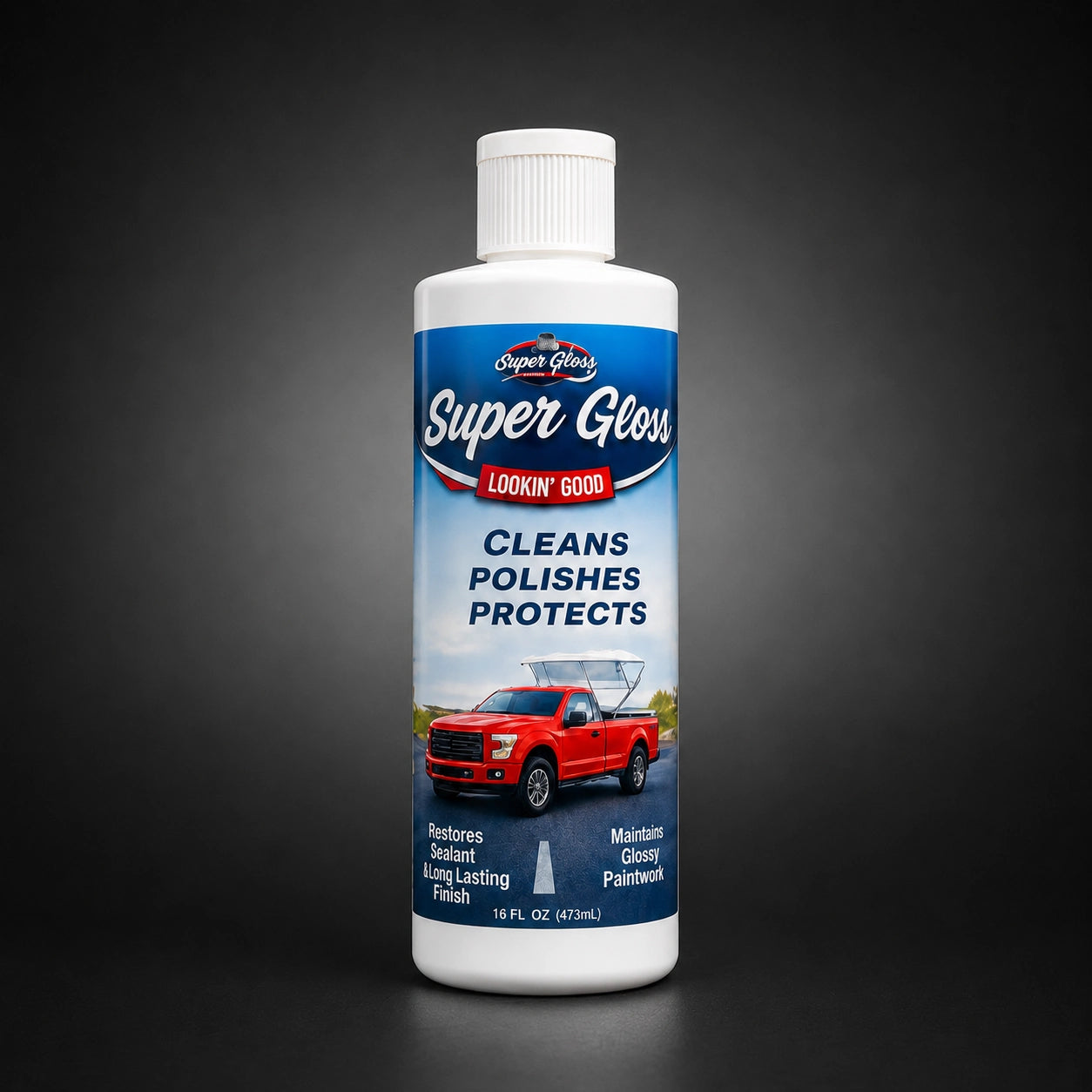
One Polish. Multiple Surfaces.
Skip the need for separate detailing products. Super Gloss combines cleaning, polishing, shining, and sealing in one multi-surface formula.
Why Aluminum Motorcycle Parts Turn Dull
Bare aluminum reacts with oxygen almost instantly and forms a thin layer of aluminum oxide. This layer is what makes polished aluminum look cloudy or flat. Moisture, road salt, brake dust, engine heat and UV exposure speed up the process. Once water and salt get involved, you may see white chalky spots or pitting. That is true corrosion, not just surface oxidation.
Common signs of oxidized aluminum on a motorcycle:
- Cloudy or milky finish
- White, chalky residue
- Pitting or small white bubbles
- Uneven shine between parts
- Rough, gritty feel after washing
Parts near the engine and exhaust (engine cases, covers, clutch and stator covers) discolor faster because of heat cycles.
Aluminum Motorcycle Parts You Can Polish
Aluminum is lightweight, strong and heat-conductive, so manufacturers use it throughout a motorcycle. The most commonly polished parts are:
- Engine covers and engine cases
- Wheels and rims
- Fork lowers and triple clamps
- Swingarms
- Footpeg brackets and foot controls
- Handlebar clamps and levers
- Side covers and cases
Step 1: Check if Your Aluminum Is Coated Before You Polish
This is the step most guides skip, and it is the main reason polishing goes wrong. Many factory motorcycle parts, especially wheels, are clear coated, painted or anodized. Polishing through a coating will remove the finish and leave patchy, hazy spots.
|
Finish type |
How to recognize it |
Can you polish it? |
|---|---|---|
|
Bare / raw aluminum |
Dull gray, oxidizes quickly, polish turns the cloth black |
Yes, full polish |
|
Clear coated |
Uniform glossy look, may peel or yellow |
No. Strip the coat first or use only a mild cleaner and wax |
|
Painted or powder coated |
Color is even and opaque |
No metal polish. Use paint-safe products |
|
Anodized |
Color-tinted, satin look, often on levers and clamps |
Avoid abrasives. Use a gentle cleaner only |
Quick test: Rub a small hidden area with a little aluminum polish on a white cloth. If the cloth turns black, the metal is bare. If nothing transfers and the surface stays glossy, there is probably a coating.
If you see peeling, cracking or hazy patches, the coating is failing. Polishing will not fix it.
Tools and Materials You Need
- Motorcycle degreaser or mild soap
- Soft brush and microfiber towels
- Wet/dry sandpaper (400, 600, 800, 1000, 1500, 2000 grit)
- Aluminum or metal polish (cutting compound plus fine finishing polish)
- Foam pad, cotton buffing wheel or dual-action polisher (optional)
- Spray bottle with water
- Painter's tape to protect paint, rubber and plastics
- Aluminum sealant or protectant
- Nitrile gloves
Step 2: Clean and Degrease the Aluminum
Dirt and oil left on the surface get ground into the metal and cause swirl marks and scratches.
- Rinse loose dirt and brake dust with water.
- Wash with mild soap or a motorcycle-safe degreaser and a soft brush.
- Let degreaser dwell briefly on oily engine cases, then agitate.
- Rinse thoroughly and dry with microfiber.
- Tape off nearby paint, plastics and rubber seals.
Homemade aluminum cleaner: For light oxidation, mix equal parts white vinegar and warm water, apply with a cloth, scrub gently, then rinse and dry right away. For stubborn spots, make a paste of baking soda and water. Neutralize and rinse well afterward. Do not use these on coated or anodized parts, and never use lye-based oven cleaner on aluminum because it attacks the metal.
Step 3: Remove Oxidation and Corrosion
Light oxidation can often be removed with polish alone. Heavier oxidation needs wet sanding first.
|
Surface condition |
Starting grit |
|---|---|
|
Light oxidation, haze |
800-1000 |
|
Moderate oxidation |
400-600 |
|
Deep scratches or pitting |
320-400 |
Wet sanding tips
- Keep the surface wet at all times. It reduces heat and clogging.
- Sand in one direction, then switch direction at each finer grit so you can see when the previous scratches are gone.
- Never skip grits. Skipping leaves marks that polish cannot remove.
- Finish at 1500-2000 grit before polishing.
- Avoid steel wool. It leaves steel particles that can cause rust spots and scratches.
Step 4: Apply Aluminum Polish
- Apply a pea-sized amount of cutting compound to a microfiber cloth, foam pad or buffing wheel.
- Work in small overlapping circles with light to medium pressure, one small section at a time.
- Expect black residue on the cloth. That is oxidized aluminum coming off.
- Switch to a fine finishing polish for extra clarity.
- Wipe residue with a clean microfiber before it dries.
Choose a polish made for aluminum or multi-metal use. Generic household cleaners will not give the same result.
Step 5: Buff to a Bright or Mirror Finish
Buffing removes leftover polish and brings out depth.
- Hand buffing with clean microfiber is safest for small parts and beginners.
- Drill-mounted pads and dual-action polishers save time on large areas like wheels.
- Bench wheels give the highest shine but carry the highest risk of heat and burn marks.
Keep the tool moving and use low pressure. Excess heat can discolor aluminum and dull the finish.
How to get a mirror finish on aluminum: wet sand progressively up to 2000 grit, use a cutting compound, follow with a finishing polish, then do a final buff. The mirror shine depends more on how smooth the sanding is than on how much polish you use.
Hand Polishing vs. Machine Polishing
|
|
Hand polishing |
Machine polishing |
|---|---|---|
|
Speed |
Slower |
Faster |
|
Control |
High |
Needs technique |
|
Best for |
Small parts, tight areas, beginners |
Wheels, large covers |
|
Risk |
Fatigue |
Overheating, burn marks |
Step 6: Seal Polished Aluminum So the Shine Lasts
Polished aluminum starts re-oxidizing within hours to days. Sealing is what keeps it bright.
Options for protecting polished aluminum:
- Aluminum sealant or protectant: A dedicated sealant forms a protective barrier against moisture, salt and UV, and cuts down on re-polishing. This is the best choice for engine cases and wheels.
- Wax: Easy and cheap but wears off faster, especially near heat.
- Clear coat: Long-lasting but difficult to repair and can yellow or peel.
To seal polished aluminum wheels: clean off all polish residue with isopropyl alcohol, apply a thin even layer of sealant, let it cure per the product directions and buff lightly. Reapply on a regular schedule, and more often if you ride in rain or on salted roads.
How to Polish Motorcycle Rims and Wheels
- Confirm the wheel is bare aluminum, not clear coated or painted.
- Remove the wheel if possible, or protect tires, rotors and brakes with tape and covers.
- Degrease heavily. Brake dust is abrasive.
- Wet sand corroded areas, then work up to fine grits.
- Polish by hand or with a drill pad, one spoke at a time.
- Seal the wheel, since wheels face constant water, brake dust and salt.
How to Polish Aluminum Engine Parts and Engine Cases
- Let the engine cool completely first.
- Degrease thoroughly. Oil film blocks polish.
- Use a soft brush for cooling fins and tight corners.
- Avoid sanding near gasket surfaces, seals and bearing areas.
- Use a heat-resistant sealant afterward, since engine cases see high temperatures.
How to Clean Motorcycle Chrome
Chrome and aluminum are different metals, so treat them differently.
- Wash with mild soap and water to lift dirt and road film.
- Remove light rust spots with a chrome polish and a soft cloth. Use aluminum foil or fine polishing wool only on genuine rust spots, with plenty of lubricant, and never on thin or flaking chrome.
- Rinse, dry and wipe with a protectant to slow rust.
Chrome polish on aluminum: Many chrome polishes are mild enough for bare aluminum. Test a hidden spot first. Do not use them on coated or anodized aluminum.
Can You Polish Aluminum to Look Like Chrome?
Yes, to a degree. Fully sanded and polished bare aluminum can reach a bright, mirror-like finish that looks close to chrome. It will be slightly softer and warmer in tone than true chrome, and it needs more maintenance because it oxidizes. Sealing it is essential to hold the look.
How to Choose the Best Aluminum Polish for Motorcycles
What to look for when choosing an aluminum polish:
- Safe for bare aluminum and, ideally, other metals you own
- Right abrasiveness: a cutting compound for oxidation, a fine polish for finishing
- Easy residue removal with no chalky film left in crevices
- Compatibility with your sealant or protectant
- Clear instructions and a good record from riders
- No harsh acids or ammonia if you plan to use it on delicate areas
Best polish by situation: heavy oxidation calls for a cutting aluminum polish after wet sanding; light haze responds to a fine finishing polish; mixed metals suit a multi-metal polish; long-term protection calls for a polish followed by a dedicated sealant.
What About Motorcycle Plastics?
Do not use aluminum or chrome polish on plastics. Use a plastic-safe cleaner and a fine plastic polish for faded or hazy fairings, windscreens and trim, followed by a UV protectant. Abrasive metal compounds can scratch and cloud them.
Common Mistakes to Avoid
- Polishing a coated surface: causes patchy, hazy results.
- Skipping sandpaper grits: leaves visible scratches.
- Polishing dirty metal: creates swirls.
- Using steel wool: scratches and leaves rust-causing particles.
- Overheating: discolors the metal, especially with machine buffing.
- Not sealing afterward: the shine fades fast.
How to Keep Polished Aluminum Shiny
- Wash regularly and dry after wet rides
- Rinse off road salt quickly
- Wipe down with microfiber between washes
- Reapply sealant periodically
- Touch up small dull spots with finishing polish before they spread
Before and After
|
|
Unmaintained aluminum |
Polished and sealed aluminum |
|---|---|---|
|
Look |
Cloudy, stained, oxidized |
Bright, reflective |
|
Feel |
Rough |
Smooth |
|
Cleaning |
Hard, grimy |
Easy to wipe |
|
Corrosion risk |
High |
Lower |
Frequently Asked Questions
How do you polish aluminum motorcycle parts?
Clean and degrade the part, wet sand oxidation from 400-600 up to 2000 grit, apply a cutting compound and then a finishing polish, buff with microfiber, and seal with an aluminum sealant.
What is the best way to polish aluminum?
Wet sanding through progressively finer grits followed by compound and finishing polish gives the best result. Heavy oxidation needs sanding; light oxidation may need only polish.
What can you use to polish aluminum?
Aluminum or metal polish, a multi-metal polish, or chrome polish (on bare aluminum only), applied with microfiber, foam pads or buffing wheels. For light haze, a vinegar and water or baking soda paste can work as a homemade aluminum cleaner.
How do you clean oxidized aluminum on a motorcycle engine?
Degrease the engine, scrub with a soft brush and mild cleaner or vinegar solution, wet sand if heavily oxidized, polish, and seal with a heat-resistant protectant.
What steps help restore shine to dull aluminum parts?
Check for coatings, clean, remove oxidation, polish, buff, and seal.
How do you clean aluminum motorcycle wheels?
Use a pH-balanced wheel cleaner or mild soap, a soft brush for spokes and barrels, rinse well and dry. Avoid harsh acids on clear-coated wheels.
Can aluminum look like chrome?
Yes. Mirror-polished and sealed aluminum can look very close to chrome, though it needs more upkeep.
How often should I re-polish and reseal?
It depends on riding conditions. Reseal when water stops beading or dullness returns, and re-polish only when oxidation reappears.
Is it safe to use chrome polish on aluminum?
Often yes for bare aluminum, but test first. Avoid it on anodized, painted or clear-coated parts.
Also Read: How to Wax a Boat?
Final Thoughts
Polishing aluminum motorcycle parts is straightforward, but the results come from preparation: confirm what finish you have, clean thoroughly, sand through every grit, polish in stages, and seal the metal. Done this way, your engine covers, wheels, forks and swingarms will stay brighter for longer between restorations.


